


is accounted for.
administrative data

Census with administrative data
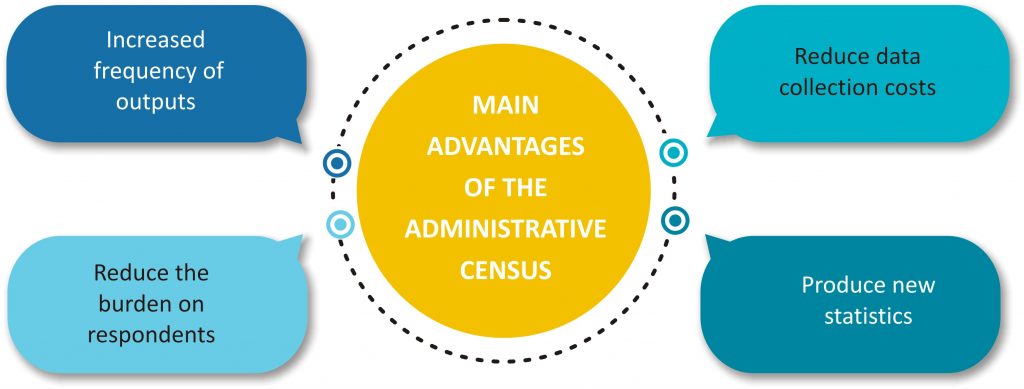
The use of administrative data is based on the need to improve the effectiveness of statistical production, through the creation of integrated systems, taking into account, on the one hand, the fulfilment of information needs and, on the other hand, the need to reduce the statistical burden on respondents, the costs inherent in the production process and to allow for more frequent data availability.
To celebrate the European Statistics Day (20 October), Statistics Portugal announces the progress of the Census with administrative data to be executed after the 2021 Census. This project is part of the National Data Infrastructure that embodies Statistics Portugal’s strategy of integration and value creation for society from different data sources. Central to the project is the constitution of the Resident Population Database covering a set of characteristics – geographical, demographic, and socio-economic – of the resident population in Portugal and results from the integration of information from various sources of the public administration.
Population and housing censuses represent one of the pillars of any National Statistical System concerning the enumeration and characterization of the population and households, at national, regional, and local levels, producing essential indicators for the definition of public policies and decision-making.
Statistics Portugal is working on the transformation of the traditional census model into a more efficient one using administrative data. Due to its dimension, this is perhaps Statistical Portugal´s most ambitious project of data integration from administrative sources.
The project is part of the development of a National Data Infrastructure which embodies Statistics Portugal’s strategy of integration and creation of value for society from different data sources. Taking advantage of Statistics Portugal´s competences, tasks and mission, the National Data Infrastructure seeks to respond to an increasingly complex society with new expectations towards statistics.
Within the scope of the Census, Statistics Portugal has been studying the contribution of available administrative data with potential to replace information collected through full enumeration (traditional model) after the 2021 Census.
The project is a key element in the strategy of paradigm shifting and places Portugal in a more favorable position regarding its international obligations, namely the production of annual census statistics after 2024 as recommended by the European Union.

About the Census
What are they and what are they for? Find out more about the Census operation.

Legislation Confidentiality
Get acquainted with the national and international legislation about the Census.
The United Nations classifies census models into three groups
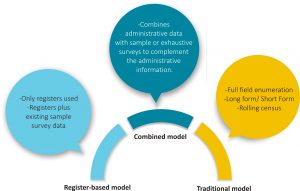
Source: Recommendations for the 2020 Censuses of Population and Housing, United Nations Economic Commission for Europe (UNECE), 2015.
The process of transition to more efficient census model began several decades ago in the Nordic countries. This movement has extended to an increasing number of countries that have evolved into registered-based or combined models.
Evolution of the census model in UNECE countries
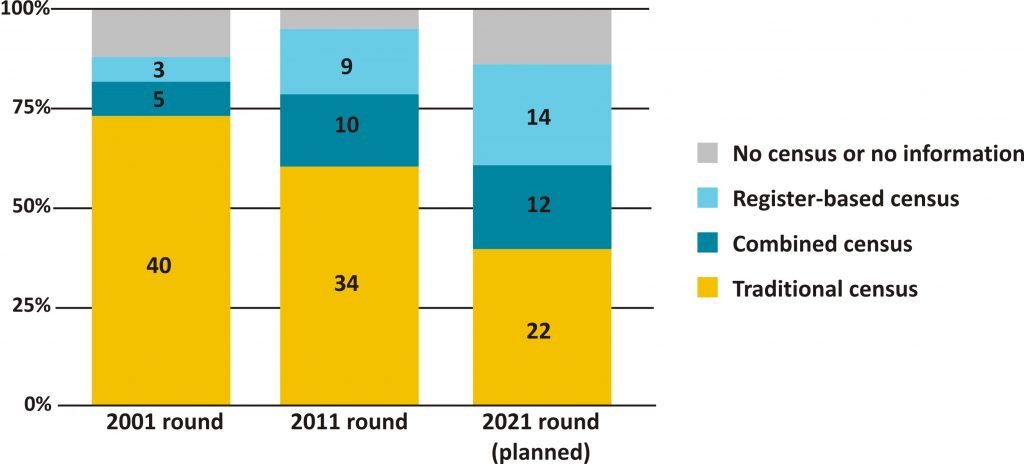
Source: United Nations Economic Commission for Europe (UNECE), 2016
Registered-based or combined census models have strong advantages in terms of the efficiency of statistical systems.
Main advantages of the administrative census
In Portugal, the Census with administrative data project was launched in 2014 as part of the feasibility study for a new census model in 2021.
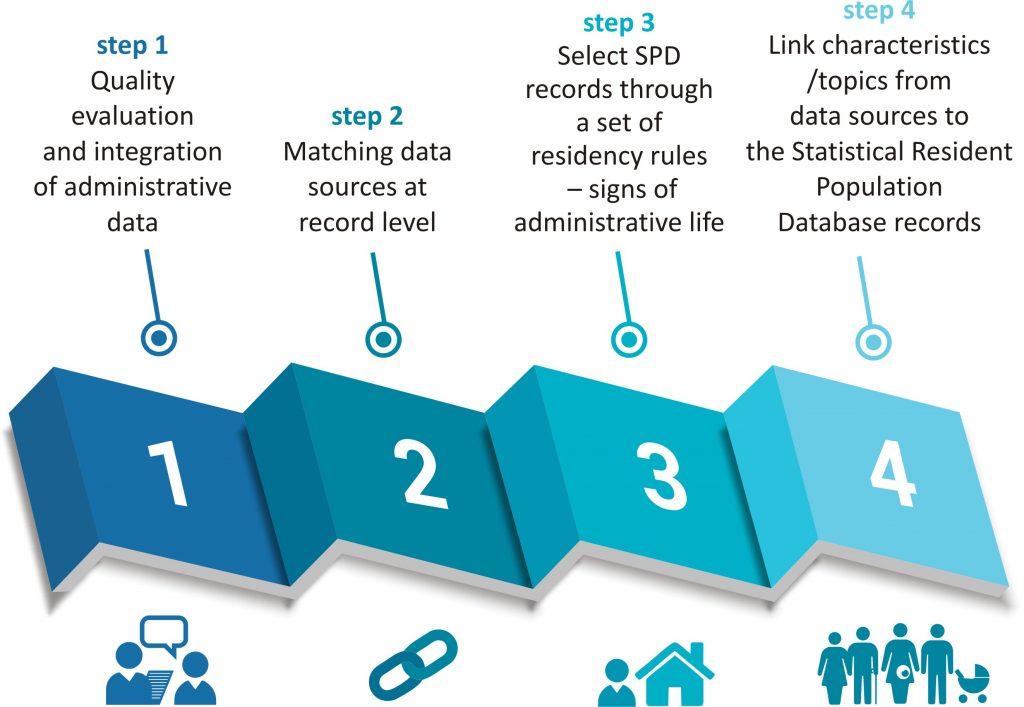
Methodological approach
The creation of the Resident Population Database requires the application of record linkage and matching techniques to integrate administrative data from different sources. Portugal does not have a unique identification number, which brings additional challenges to data integration from multiple sources at a record level. It is necessary to determine whether a person lives in the national territory, which corresponds to the concept of resident population associated with census operations. To implement this concept, a set of rules known as “signs of life” is applied. These rules make it possible to validate residency in Portugal considering the presence of the individual in the different administrative data sources (e.g. the individual works, attends the education system, pays taxes, is registered in the employment office,…).
Once the resident population has been estimated, the administrative variables of census interest, which allow for the characterization of the population in different domains, are subsequently associated.
The reference date for the Resident Population Database is December 31. Three annual exercises have been carried out so far.
Key results: 2017 Population figures
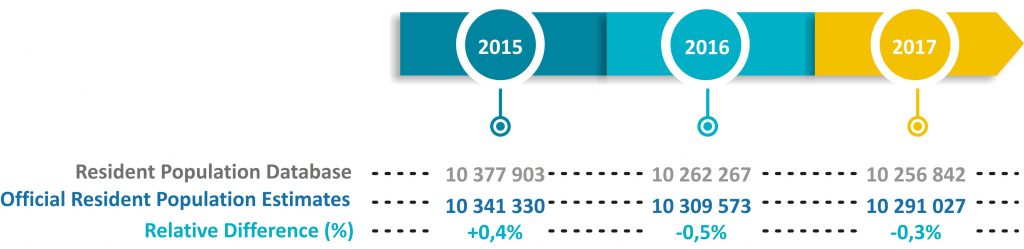
The population estimated through administrative data by the Resident Population Database is 10,256,842 persons for 2017, which represents a deviation of only -0.3% compared to the same year official resident Population Estimates published by Statistics The Portugal resident Population Estimates provide the official figures of the resident population in Portugal that adopts the components by cohort method and applies the population census concept (currently anchored in the 2011 Census). Its calculation is based on the natural and migratory demographic components originated from other statistical operations of Statistics Portugal: live births; deaths; emigration and immigration estimates.
The results obtained in the Census with administrative data project are very optimistic, considering the different assumptions, methodologies, and distinct sources of these two statistical studies: Resident Population Database and official Resident Population Estimates.
2015 to 2017 resident Population: Resident Population Database, official Resident Population Estimates and relative difference
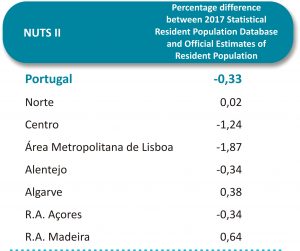
At the regional level (NUTS II) the differences between the 2017 Resident Population Database and the official Resident Population Estimates for the same year vary between -1.87% and 0.64%.
Resident population by NUTS II 2017: Difference between Resident Population Database and official Resident Population Estimates, %.
Source: INE, I.P., official Resident Population Estimates, 2017; Resident Population Database, 2017.
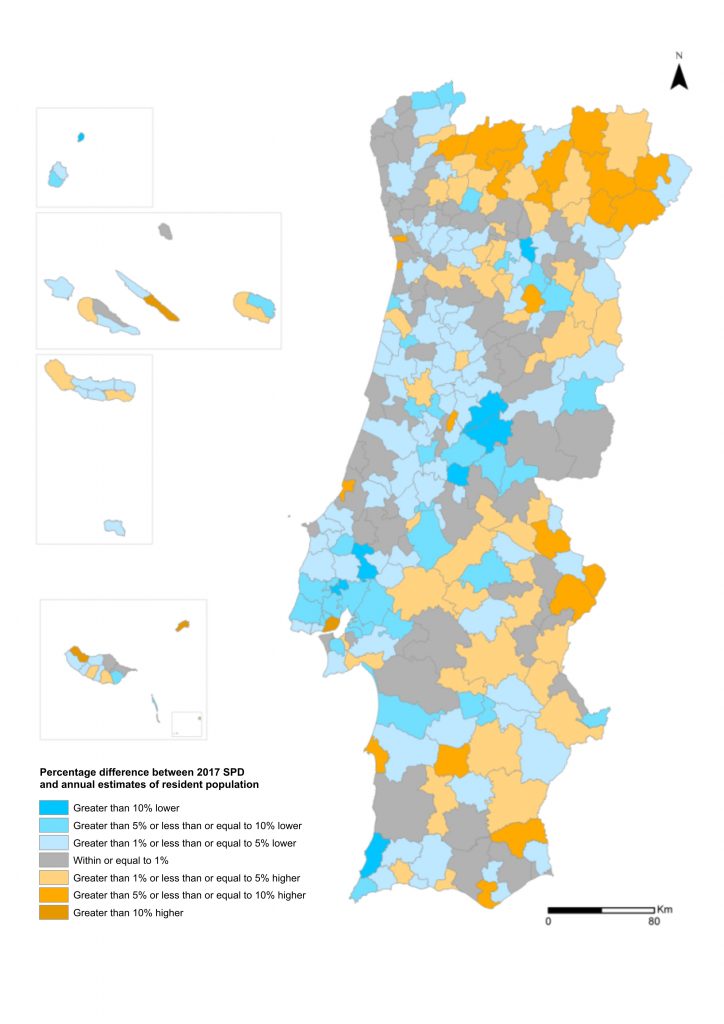
The results of the Resident Population Database are also promising at the municipality level: for 2017, more than 76% of 308 municipalities present levels of under or over coverage, when comparing to the official Resident Population Estimates, lower than 5%; it should be noted that in 77 municipalities, the relative differences vary between -1% and 1%. Only a small number of municipalities (10) show relative differences greater than 10% (higher or lower).
Resident population by municipality 2017: Difference between Resident Population Database and official Resident Population Estimates, %.
Source: INE, I.P., official Resident Population Estimates, 2017; Resident Population Database, 2017.
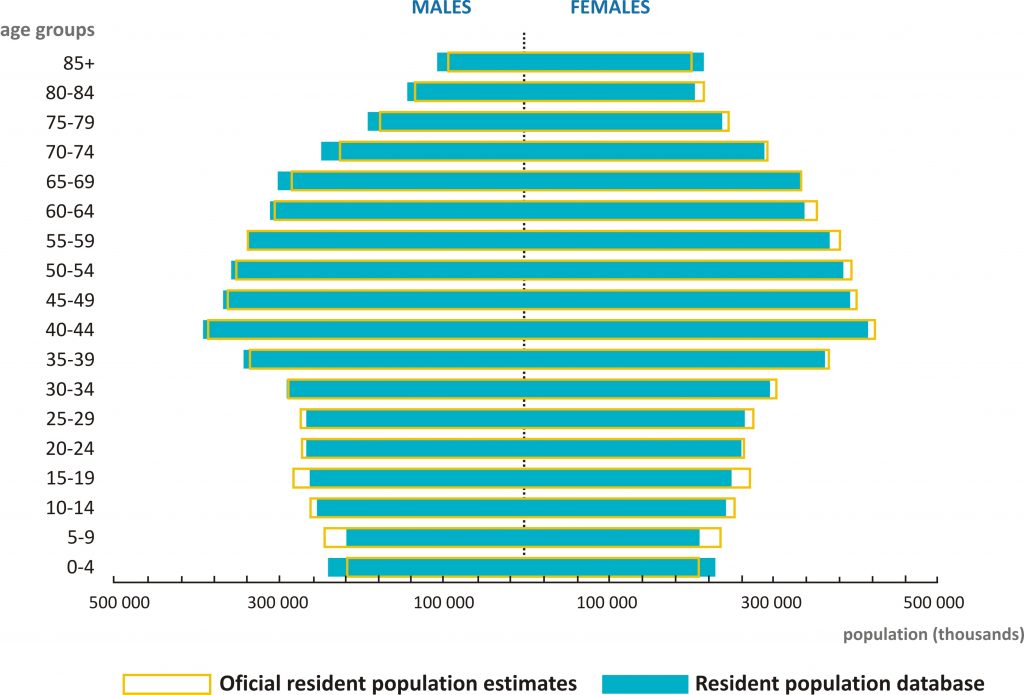
Combined with the geographical distribution, the Resident Population Database already captures part of the demographic and socioeconomic dimensions. For example, the differences in the age structures of the resident population from these statistical studies are negligible for most age groups.
Population by age group and gender, 2017: Resident Population Database and official Resident Population Estimates
Source: INE, I.P., official Resident Population Estimates, 2017; Resident Population Database, 2017.
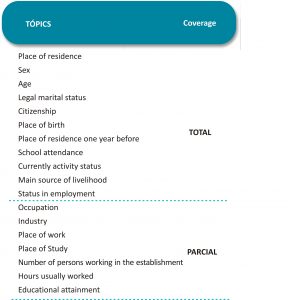
The Resident Population Database currently provides information for 18 census variables, of which 11 fully characterize the resident population and seven have partial coverage. In the area of employment and labor market, for example, there is still no information on the occupation for public servants.
Census variables available in the Resident Population Database
Welcome to the Census 2021
An effective and convenient Census for the entire population.
Final considerations and future developments
The set of administrative information currently integrated in the Resident Population Database has a high potential for the transition to a registered-based census model. However, several critical areas have been identified that make the immediate transition to an administrative model unfeasible in the 2021 Censuses:
- Access to all the administrative information required for the Census;
- Total coverage in all mandatory census variables;
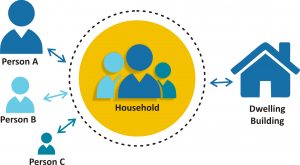
- Information on family structures and housing;
- Dissemination to some geographical levels (Grid 1Km2).
The availability of administrative data is still incomplete, either due to the need for formal access protocols or due to information that needs to be derived from the raw microdata. The case of family structures is paradigmatic, in which it is necessary to ensure access to data concerning affiliation relationships and subsequent treatment to apply the concepts of household and family nucleus.
It will also be necessary to analyze and treat the addresses and, through the geo-referencing of buildings, develop a solution for the dissemination of population statistics by a geographical grid of 1Km2.
The Census with administrative data project is a strategic line of work for Statistics Portugal, capable of meeting the requirements of official statistical information. Ultimately, there will even be a continuous census that could be updated in an infra-annual period, provided that administrative sources allow such frequency.
The Resident Population Database provides an information structure that, when integrated with additional data, for example on income and housing, will allow the creation of new statistical indicators and expand the possibilities of analysis (e.g., the incidence of poverty or of school dropout), with greater geographical, demographic, and socio-economic detail.
Integration of information on individuals, households and housing
Statistics Portugal thanks the Public Administration Entities that contribute with administrative data and make possible the implementation of this project, essential for the modernization of the National Statistical System.
Becoming familiar with Statistics Portugal’s website
Access the data and findings of the previous Census and keep informed about the most recent studies on, for example, employment, migrations, the national GDP, and the Covid-19 pandemic.
2011 Census
Get to know all about the population, households, and housing portraited by the last Census conducted in Portugal.
